Question 1 BDS - DENTAL MATERIAL - GYPSUM PRODUCT Easy
Water powder ratio of dental stone and plaster is respectively
A
0.28 and 0.6
B
0.6 and 0. 28
C
0.6 and 3.2
D
0.28 and 0.98
Question 2 BDS - DENTAL MATERIAL - GYPSUM PRODUCT Medium
Type III Dental gypsum is
A
Class II stone
B
Densite
C
Class I stone or hydrocal
D
Model or lab plaster
Explanation
Type I Impression plaster Type II Model plaster Type III (Class I stone) Dental stone / Hydrocal Type IV (Class II stone) High strength stone or improved stone TYPE V Dental stone of high strength & high expansion
Question 3 BDS - DENTAL MATERIAL - GYPSUM PRODUCT Medium
Model plaster (white) used to cast study models before mixing with water, is largely composed of
A
Cao
B
CaSO4.12H20
C
CaCO3
D
CaSO4.2H2O
Explanation
Gypsum products are supplied as fine hemihydrate (CaSO4.12H20 or (CaSO4)2 H2O) powders that are produced by heating ground gypsum particles. After mixing with water, the mixture reverts to gypsum (CaSO4.2H2O). The reaction is exothermic in nature. (CaSO4)2 H2O + 3H2O 2CaSO4.2H2O
Question 4 BDS - DENTAL MATERIAL - GYPSUM PRODUCT Easy
Beta hemihydrate particles absorb
A
more water
B
less water
C
no water
D
none of the above
Explanation
B-hemihydrate particles absorb more water, because the crystals are more irregular in shape and are porous in character.
Question 5 BDS - DENTAL MATERIAL - GYPSUM PRODUCT Medium
The product, which is obtained by calcining gypsum gypsum in the presence of sodium succinate, is under steam pressure at 120-130°C or by dehydrating
A
Alpha - hemihydrates
B
Beta - hemihydrates
C
Calcium sulphate dihydrate
D
Orthorhombic anhydrate
Explanation
Calcination of gypsum at 110° 120° C results in formation of CaSO4.¹½ H₂O, which is a constituent of dental plasters and stones. Calcination under steam pressure or by dehydration, in presence of succinate and calcium chloride produces a-hemihydrate. Dry calcination produces ẞ-hemihydrate
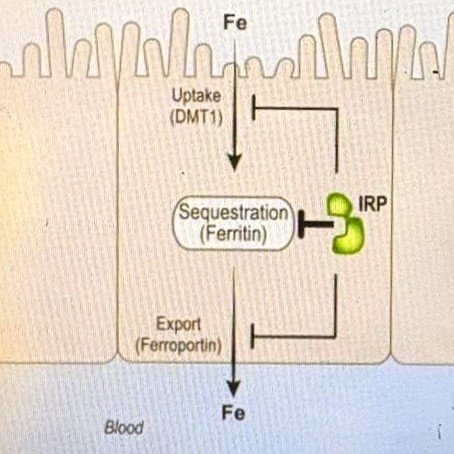
Question 6 BDS - PHYSIOLOGY - GIT &LIVER Easy
The figure shows Intestinal lumen---- _ of iron in the small intestine.
Question Image
A
Adsorption
B
Reabsorption
C
desorption
D
Absorption
Question 7 BDS - PHYSIOLOGY - GIT &LIVER Easy
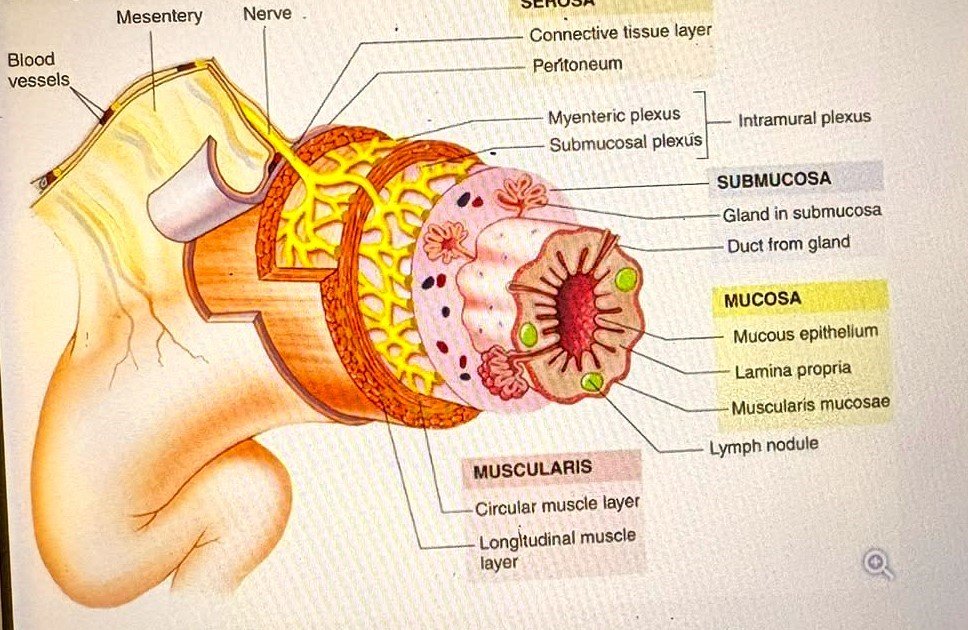
The figure shows cross section of
Question Image
A
Gastrointestinal tract
B
Skeletal muscle
C
Non striated muscle
D
Cardiac muscle
Question 8 BDS - PHYSIOLOGY - GIT &LIVER Easy
The final sugars in intestinal chyme are
A
Glucose & fructose
B
Ribose & mannose
C
Ribose & xylulose
D
Xylulose & fructose
Explanation
The amylolytic enzymes present in intestinal juice convert disaccharides into monosaccharides (glucose and fructose).
Question 9 BDS - PHYSIOLOGY - GIT &LIVER Medium
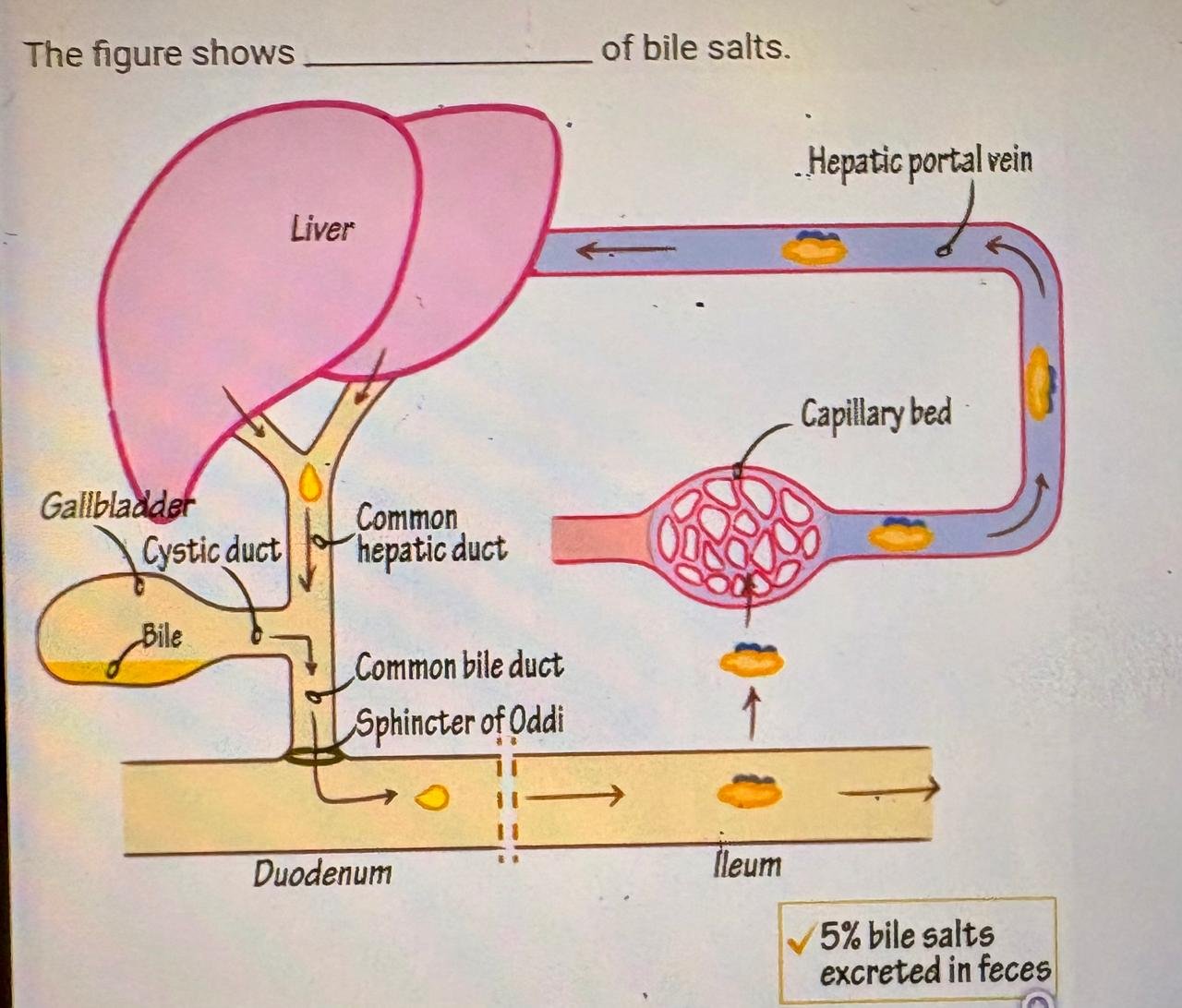
The figure show_______of bile salts
Question Image
A
Entero-hepatic circulation
B
Hepatic circulation
C
Portal circulation
D
none
Question 10 BDS - PHYSIOLOGY - GIT &LIVER Easy
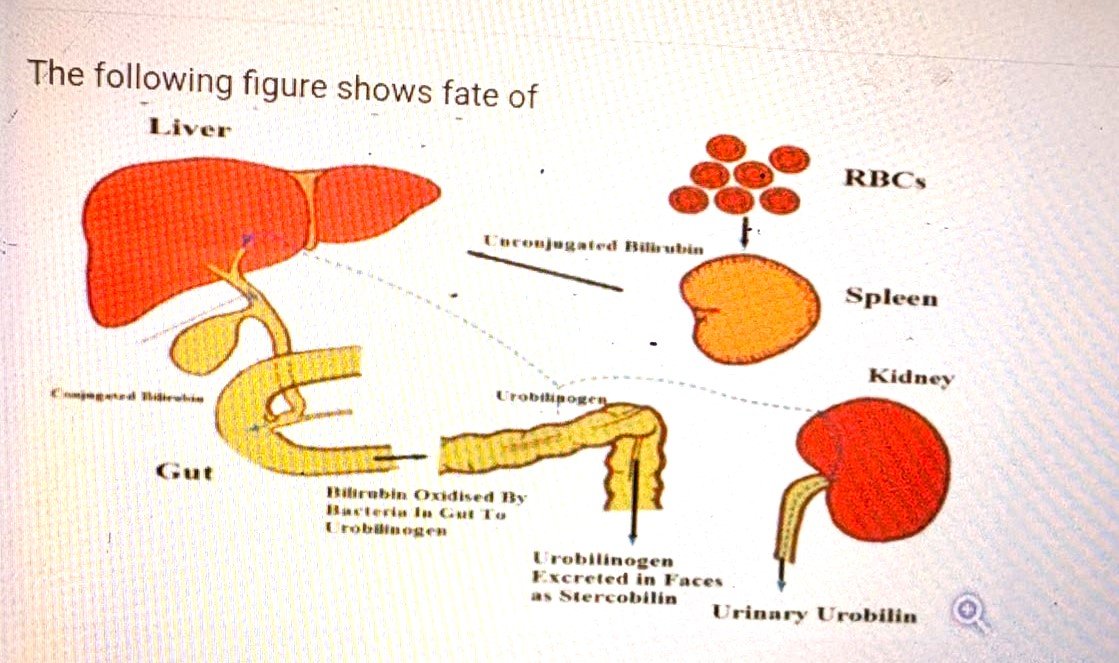
The following figure shows fate of
Question Image
A
Bilirubin
B
Urobilinogen
C
Billverdin
D
None
Question 11 BDS - PHYSIOLOGY - GIT &LIVER Medium
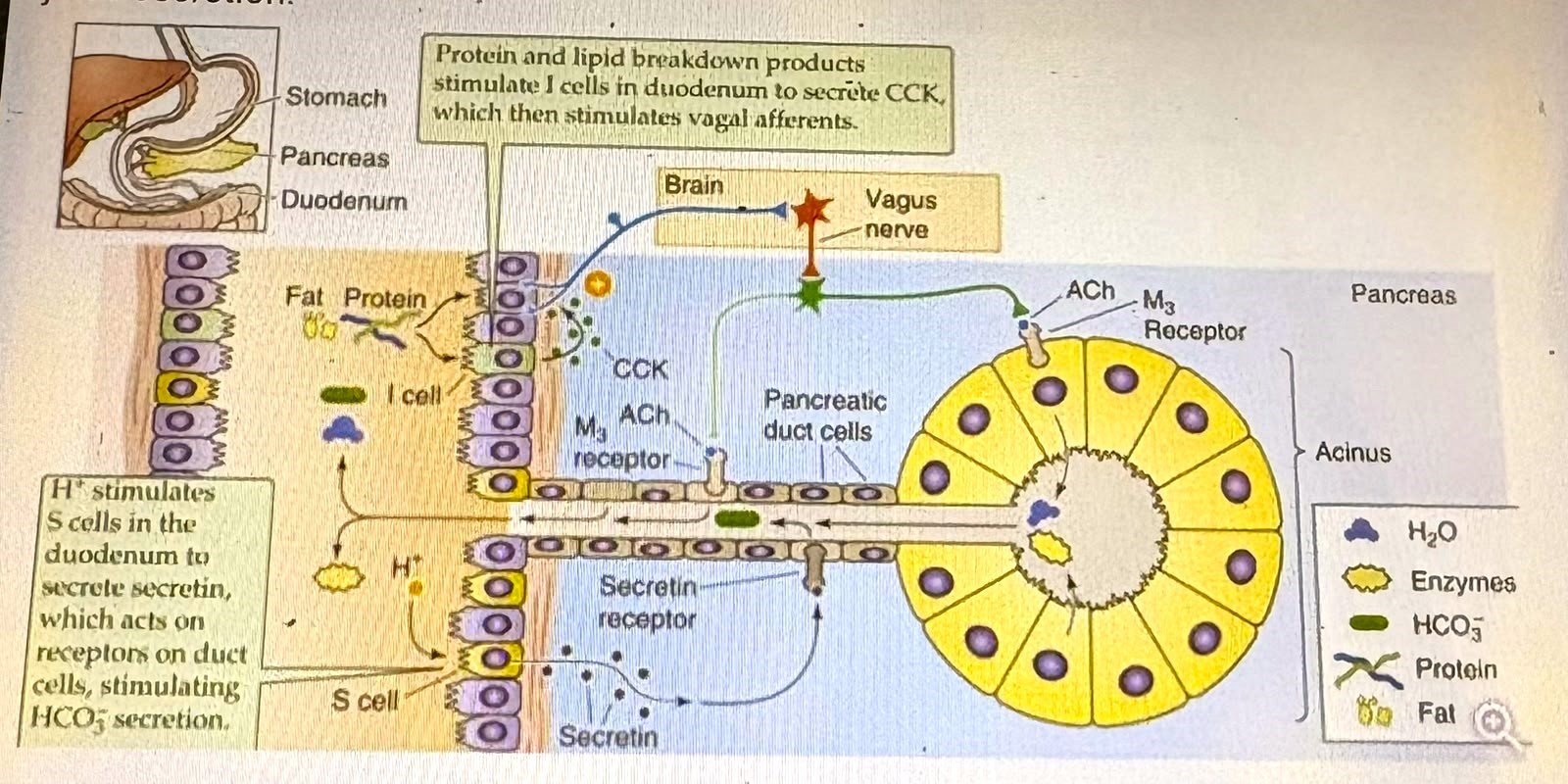
The figure shows sites of action and effects of secretin and julce secretion.
Question Image
A
Adrenaline
B
Cortisol
C
Cholecytokinin-pancreozymin
D
Estrogen
Explanation
The figure depicts two intestinal-phase hormones: secretin (S cells, H* stimulus, HCO3-rich juice via duct cells) and CCK-PZ (I cells, fat/protein stimulus, enzyme-rich juice via acinar cells) CCK-PZ fills the blank - I cells release it in response to fatty acids and peptides; it acts on acinar cells via IP, and also via vagal afferents → ACh → M₃ receptors (both pathways shown in the figure)
Question 12 BDS - PHYSIOLOGY - GIT &LIVER Medium
Gallbladder contraction is controlled primarily by the folllowing hormone
A
Pancretozymine
B
Glucagon
C
Secretin
D
Cholecystokinin-pancreozymin
Explanation
Cholecystokinin-8 placed in the gallbladder lumen causes gallbladder contraction by a neurally mediated, tetrodotoxin-sensitive mechanism.
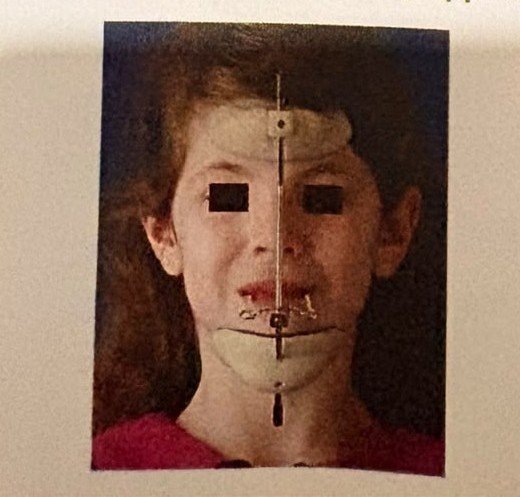
Question 13 IMAGE BASED MCQ - ORTHODONTIC - REMOVABLE APPLIANCE Hard
Identify the following appliance
Question Image
A
Delaire face mask
B
Petit face mask
C
Tubinger face mask
D
None of above
Question 14 IMAGE BASED MCQ - ORTHODONTIC - REMOVABLE APPLIANCE Medium
Identify the following appliance
A
Twin block-delta clasp
B
Twin block-Adams clasp
C
Activator-delta clasp
D
Activator-Adams clasp
Question 15 IMAGE BASED MCQ - ORTHODONTIC - REMOVABLE APPLIANCE Medium
Identify the following appliance
A
Posterior bite plane
B
Kesling tooth positoiner
C
Anterior bite plane
D
None of above
Question 16 IMAGE BASED MCQ - ORTHODONTIC - REMOVABLE APPLIANCE Easy
The myofunctional appliance shown in the below picture is used in treatment of
A
Class III malocclusion
B
Class II malocclusion
C
Class I malocclusion
D
Class I bimax malocclusion
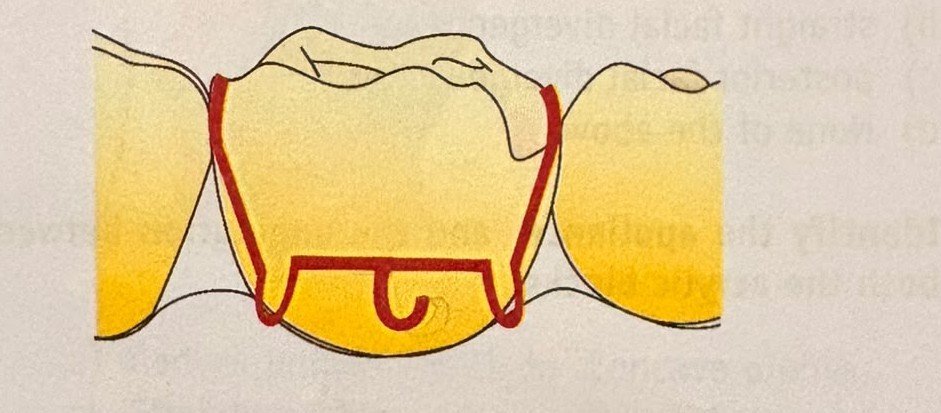
Question 17 IMAGE BASED MCQ - ORTHODONTIC - REMOVABLE APPLIANCE Hard
Identify the following
Question Image
A
Adams with helix
B
Adams with j hook
C
Adams with single arrow head
D
Adams with distal extension
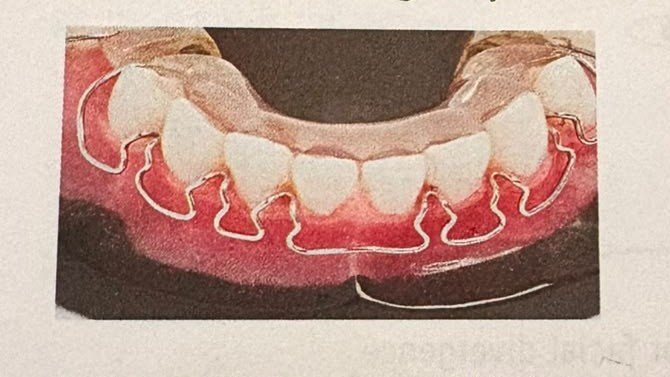
Question 18 IMAGE BASED MCQ - ORTHODONTIC - REMOVABLE APPLIANCE Medium
Identify the clasp
Question Image
A
Crozat clasp
B
Delta clasp
C
Schwarz clasp
D
Triangular clasp
Question 19 BDS - DENTAL MATERIAL - Physical properties Easy
The area under the stress–strain curve up to fracture represents:
A
. Modulus of elasticity
B
Resilience
C
Toughness
D
Yield strength
Question 20 BDS - DENTAL MATERIAL - Physical properties Easy
Which property is particularly important for gypsum casts to resist abrasion during manipulation?
A
Hardness
B
Ductility
C
Creep
D
Plasticity
Question 21 BDS - DENTAL MATERIAL - Physical properties Easy
The ability of a material to absorb energy before fracture is called:
A
Toughness
B
Stiffness
C
Elasticity
D
Hardness
Question 22 BDS - DENTAL MATERIAL - Physical properties Easy
The ability of a material to resist deformation under an applied load is called:
A
Hardness
B
Stiffness
C
Toughness
D
Resilience
Question 23 BDS - DENTAL MATERIAL - Physical properties Easy
Time dependent plastic deformation of a material is called as
A
Creep
B
viscosity
C
Flow
D
Elasticity
Explanation
Creep time-dependent plastic (irreversible) deformation of a material under a constant static load, occurring near the material's melting point Clinically significant in dental amalgam-low melting range makes it susceptible to creep under sustained occlusal stress marginal ditching and restoration failure
Question 24 BDS - C0MMUNITY DENTISTRY - Epidemology Medium
Objective of calibrating examiner before survey is to (AIPG-2017)
A
Measure consistently at different times and under a variety of conditions
B
Ensure uniform interpretation, understanding and application of diagnostic criteria
C
Increase Intra- and inter examiner reliability
D
All of the above
Question 25 BDS - C0MMUNITY DENTISTRY - Epidemology Easy
If a young female patient refuses to be tested for HIV as a precondition for dental treatment, the dental surgeon must:
A
Refer this patient to other doctor or hospital
B
Insist for HIV test
C
Accept the case with an additional fee
D
Not refuse the treatment but all infection control methods must be practiced
Explanation
Universal precautions apply to every patient as if potentially infectious HIV status is irrelevant to the infection control protocol ADA Code of Ethics (1988): Refusing dental treatment solely because a patient is HIV-positive or refuses HIV testing is both unethical and illegal Patient has the legal right to refuse HIV-related testing; requiring it as a precondition violates patlent autonomy Treat normally with strict infection control (gloves, mask, eye protection, sterilisation of instruments) - this is the legally and ethically correct approach
Question 26 BDS - C0MMUNITY DENTISTRY - Epidemology Easy
The most difficult source of infection among the following is (AIPG 2010)
A
vector borne
B
air borne
C
human to human
D
vertical
Explanation
Airborne is the most difficult to control - droplet nuclei (< 5 um) remain suspended in air for prolonged periods, travel long distances, and require specialized engineering controls negative pressure rooms, HEPA filters, N95 respirators) that are difficult to scale * Other routes have targetable interruption points: vector-borne → kill the vector; vertical → screen and treat the mother, human-to-human → isolate, vaccinate, barrier precautions * High Roof airborne diseases (Measles Ro = 12-18; TB) reflects the inherent difficulty of containment * Examples of airborne pathogens: M. tuberculosis, Measles virus, Varicella-zoster virus smallpox
Question 27 BDS - C0MMUNITY DENTISTRY - Epidemology Medium
A researcher is interested in recording the number of individuals in a particular geographic region who have a common cold on a specific day. (e.g., February 15th). Which of the following measures of morbidity would be most appropriate in answering this question? (COMDEK-2015) PGI-PG
A
Incidence
B
Point
C
Point prevalence
D
None of above
Explanation
Point prevalence - all existing cases (old + new) at a single point in time * "February 15th" is a specific calendar date → one frozen moment → point, not a period * Distinguishing feature vs. period prevalence: period prevalence spans a duration (e.g., a week or month):
Question 28 BDS - C0MMUNITY DENTISTRY - Epidemology Easy
Incidence refers to
A
All existing cases of disease
B
New cases occurring during a specified period
C
Deaths due to a disease
D
Proportion of diseased individuals who die
Explanation
Incidence = new cases occurring in a population at risk during a specified time. Prevalence = all existing cases (old + new). Incidence is useful for studying risk of developing disease.
Question 29 BDS - GENERALANATOMY - OSTEOLOGY Easy
Which of the following statements about the hypoglossal canal is true?
A
Transmits hypoglassal nerve
B
Transmits meningeal branch of ascending pharyngeal artery
C
Lies in posterior craninal fossa
D
All of the above
Explanation
* Hypoglossal canal = anterior condylar canal - located in the occipital bone, opening internally into the posterior cranial fossa * Transmits: CN XII (hypoglossal nerve) + meningeal branch of ascending pharyngeal artery + meningeal branch of CN XII (C1 fibres) + emissary vein (sigmold sinus → IJV) * All three statements (A, B, C) are correct → D (All of the above) * The meningeal branch of the ascending pharyngeal artery is the most commonly missed content in exam preparation
Question 30 BDS - GENERALANATOMY - OSTEOLOGY Easy
The point where the parieto mastoid, occipito mastoid, and lamboid sutures meet is:
A
Bregma
B
Obelion
C
Pterion
D
Asterion
Explanation
Asterion = junction of parietomastoid + occipitomastoid + lamboid. sutures → meeting of parietal, occipital, and mastold (temporal) bones * Located posterolaterally on the skull * Overlies the transverse-sigmoid sinus junction - key surgical landmark for posterlor fossa/retrosigmoid approaches * Most common site of Wormian bones (along with lambda) * Not to be confused with pterion frontal + parietal + sphenoid + squamous temporal; overlles middle meningeal artery
Question 31 BDS - GENERALANATOMY - OSTEOLOGY Easy
Which of the folowing is unpaired bone of facial skeleton
A
Nasal
B
Lacrimal
C
Inferior nasal concha
D
Vomer
Explanation
The facial skelston has 14 bones :6 paired (12 bones )+2 unpaired (vomer+mandible).Vomer is single midline bone forming the posteroinferior nasal septum -one of two unpaired facial bones
Question 32 BDS - GENERALANATOMY - OSTEOLOGY Easy
The natural ostium of the maxillary sinus opens high up on its medial wall into the semilunar hiatus of the middle meatus. What critical functional and clinical challenge does this specific anatomical positioning create in an upright human?
A
It prevents dependent gravity drainage in the upright posture ,making the sinus entirely dependent on active mucociliary transport
B
It allows continuous passive gravity drainage into inferior nasal meatus regardless of head position
C
It connects directly with the middle cranial fossa via accessory ostia to equalize intracranial pressure.
D
It ensures rapid negative pressure equalization by draining directly into the pterygoid venous plexus.
Explanation
Because the natural ostium is located near the roof of the maxillary sinus, fluid cannot drain by gravity when the head is upright. Drainage relies completely on the coordinated action of the ciliary epithelium moving mucus upward and outward toward the opening.
Question 33 BDS - GENERALANATOMY - OSTEOLOGY Hard
During an inferior alveolar nerve block injection, the dental surgeon targets the mandibular foramen on the medial surface of the ramus. This foramen is overlapped medially by a sharp, tongue-shaped bony projection. What is the specific name of this landmark and which prominent ligament attaches directly to its apex?
A
Coronoid process and the temporalis tendon
B
Lingula and the sphenomandibular ligament
C
Mylohyoid line and the mylohyoid ligamen
D
Mental spine and the genioglossus muscle
Explanation
The lingula is a tongue-like bony projection overlapping the mandibular foramen anteriorly, and its apex and posterior margin serve as the attachment site for the sphenomandibular ligament (a derivative of Meckel's cartilage).